 Snow Day
Will school be cancelled tomorrow?
Pick your town. Snow Day gives you one number, from 3 to 97%, built from tonight's hourly snowfall, how much snow your town normally gets, and National Weather Service winter alerts. Then Mel, the snowman, takes it personally.
Coming to the App Store this November
$2.99 once. No account, no ads, no subscription.
Not official — your district decides.
Three things decide it. Then the Weather Service gets a say.
How much snow, when it lands, and how much your town usually gets. The number is the odds there's no in-person school. Closed counts. A remote day counts. A two-hour delay doesn't. You still have to go.
Forecasts come from Apple Weather. Snow Day does the rest on your phone.
When it lands
Snow from noon the day before to 3pm on the day counts, including what already fell. Midnight to 7am counts in full: that's when the superintendent is up making the call. The evening before counts 80%, the afternoon before 35%. Once the buses are rolling it fades fast: 60% from 7 to 9am, 25% mid-morning, 35% after that, which is early-dismissal territory.
How much snow counts by when it falls: Noon–6pm the day before, 35%; 6pm–midnight, 80%; Midnight–7am, 100%; 7–9am, 60%; 9–11am, 25%; 11am–3pm, 35%. How much
Apple Weather gives a low, an expected and a high snowfall. The odds blend all three, so a storm that could go either way lands closer to the middle. Right around freezing, some of it comes down as rain or slush, so those hours count less. Sleet counts as snow. It's just as bad on a bus route.
Your town's normal
Buffalo shrugs at four inches. Atlanta closes for one. So Snow Day looks up how much snow your town normally gets in a year and sets the amount that makes it a coin flip there. About twice that gets you into the 90s.
- Atlanta
- 0.7″
- Hartford
- 4.1″
- Buffalo
- 8.1″
Roughly what makes it a coin flip
Weather Service alerts
An active winter alert from the National Weather Service nudges the odds up: a Blizzard Warning the most, then Winter Storm, Ice Storm and Lake Effect Snow Warnings, then Watches, then Advisories. Only the strongest one counts, and only if the forecast actually has some snow in it. Extreme cold alerts show up too, but they aren't in the odds yet.
Mel takes it personally.
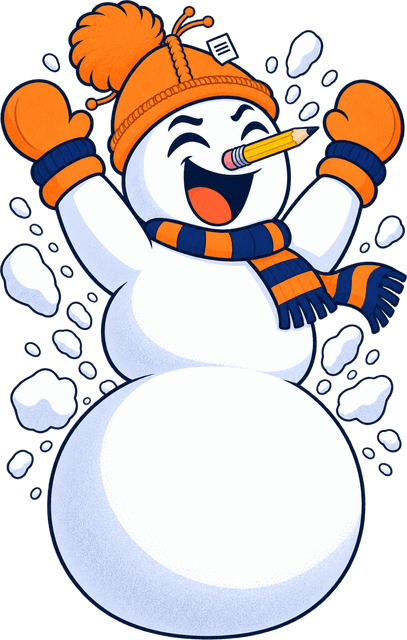
Mel is a snowman with a #2 pencil for a nose and his beanie on inside out, for luck. At 3% he's a puddle. At 97% he's three snowballs tall and yelling.
Why never 0 or 100? Nobody knows for sure until the call goes out, including the person making it.

3–14%
NO CHANCE
“Do the homework. All of it.”

15–34%
UNLIKELY
“Pretty, but not cancel-school pretty.”

35–59%
TOSS-UP
“Genuine coin flip. Do half the homework.”

60–84%
LIKELY
“Odds are good. Don't do the homework yet.”
85–97%
LOCK
“Find the sled. This is the one.”
Know which night to worry about.
The next five school days each get their own number, so a storm on Thursday doesn't sneak up on you Wednesday at 10pm. Holidays say “No school”. Check again later, and if the number moved, it tells you by how much.
- Tuesday87%
- Wednesday41%
- Thursday9%
- Friday3%
- MondayNo school
41% → 87%
since the last check
Send it to the group chat. Collect in the morning.
One tap turns tonight's number into a card: the odds, Mel, the one-liner, your town and the time you checked. Send it, put it on your Instagram Story, or save it to Photos. The card is made on your phone.
The morning after, Snow Day asks what happened. Closed, remote, delayed or open, one tap. Get it right and you get the CALLED IT card, and your record goes up. Get it wrong and the record says that too.
Odds look off? Tell us.
Snow Day's odds come from a model we keep tuning. After real storms, we compare what it said with what districts actually did, and adjust.
If your town keeps reading too eager or too stingy, email us the town and the day. That's exactly the kind of miss that makes the next call better: admin@loriccoandco.com
Your “Did it happen?” taps stay on your phone, so an email is the only way we hear about it.
$2.99.
Once.
Coming to the App Store this November
- Pay once
- Every feature. No subscription, no in-app purchases.
- No account
- Nothing to sign up for. Your towns, settings and record stay on your phone.
- No ads, no tracking
- No ad SDKs, no analytics. Forecasts come from Apple Weather and the odds are worked out on your phone.
- iPhone
- iOS 18 or later. Coming to the App Store this November.
Questions
Anything else is on the support page.
Is it official?
No. Snow Day isn't connected to any school or district, and it can't hear the superintendent's phone tree. It's an estimate from public forecast data. Your district decides, and your district's call is the only one that counts.
Where does the data come from?
Apple Weather: the hourly snowfall forecast (low, expected and high), your town's monthly climate normals, and active weather alerts, which are issued by the National Weather Service. Snow Day turns them into its own odds on your phone.
Does a two-hour delay count?
No. The number is the odds there's no in-person school: closed or remote. A delay means you still have to go, so it doesn't count.
Does it work outside the US?
The forecast works anywhere Apple Weather does. The alerts come from the National Weather Service, so they're US only, and the holidays it knows about (Thanksgiving, winter break, MLK Day, Presidents' Day) are US school holidays. Outside the US the odds come from the snow forecast and your town's normal alone.
What about ice or extreme cold?
Sleet counts as snow. Freezing rain and wind chill aren't in the odds yet. Extreme cold alerts show up in the app, because cold closes schools too, but they don't move the number.
Do you track me?
No. No account, no ads, no analytics. If you share your location, the coordinates go to Apple to get your forecast and never come to us. You can search for a town instead. The privacy policy has the details.
How much is it?
$2.99, once. No subscription, no in-app purchases, no ads.
When can I get it?
November 2026, before the first real storm. It's an iPhone app (iOS 18 or later). This page gets the App Store link the day it's live.